Text types: General Descriptions
|
Identifying the topic | |
Classifying and defining
Classifying
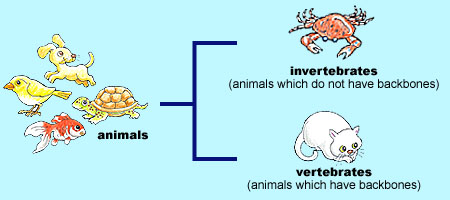
When we organise our knowledge about an animal, we usually begin by classifying the animal, that is, identifying which class or category the animal belongs to. Here is a simple chart which primary school students might use in order to classify an animal. On this chart there are two categories, or classes, of animals, ie invertebrate and vertebrate:
We can use this chart to classify bats with a sentence in which the relating verb are relates bats to the class vertebrates:
The word vertebrates is a technical term. We give a technical term meaning by defining
it. In the following example, the sentence defines vertebrates. In
this sentence the verb are
relates the technical term vertebrates to a noun group  . The noun group has a
qualifier which tells us which characteristic of an animal makes it a vertebrate.
. The noun group has a
qualifier which tells us which characteristic of an animal makes it a vertebrate.
Classifying and defining in the IDENTIFICATION
stage
In the IDENTIFICATION stage of the general description of Bats, our knowledge about bats is organised by classifying and defining. In the DESCRIPTION stage of the general description of Bats, our knowledge about bats is organised by classifying.
The sample text Bats uses the following sentences in the IDENTIFICATION stage:
Bats are mammals. (classification)
They are flying mammals. (classification)
They are the only mammals which can fly. (definition)
There are two types of bats, mega bats and micro bats. (sub-classification)
These sentences identify bats based on the classification system illustrated in the following chart:
Classifying in the DESCRIPTION
stage
The DESCRIPTION stage of a general description uses classifiers in noun groups to answer the question 'What kind of ...?' Sometimes classifiers are nouns, sometimes they are adjectives and sometimes they are verbs.
Here are some examples from the sample general description:
| To see how relating clauses, technical terms and noun groups are used to classify and define in the general description of bats click here: |
|
|
Tell me more ... Focus on grammar |
 |
 |
 |
|
||
To give us feedback about this section, click here or on the Comment button at the top of the screen.
If you have any questions about this section, visit the Language Corner.
If you have any questions or suggestions about how to teach this section, send a message to the Teaching Corner.