
Text types: Texts for fun & leisure
|
Letters |
What are letters?
 |
||
 |
Letters are a conventional means of communication between people who are separated by distance. People have been writing letters to each other for thousands of years. However, the tradition of writing letters and sending them in envelopes with pre-paid stamps is much more recent. It was only in the 19th century that letter writing became widely popular, as transport and shipping services opened up, and railways were developed. We can distinguish between personal letters and formal letters (often business related). The traditional way of sending a letter is by post. However, recent advances in technology mean that we can now send letters by fax machine or via the Internet through email (electronic mail). |
 |
 |
||
Personal letters
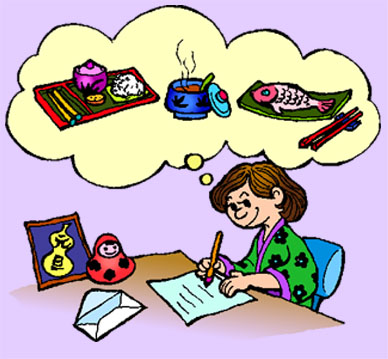 |
Personal letters are a conventional means of private communication (either
hand written or word processed). They are typically exchanged between people who
know each other well. The main function of personal letters is to enable us to maintain relationships with our family
and friends who are living in other places.
Of course we can (and do) also maintain relationships in other ways such as over the telephone, but letters allow us to organise our thoughts and control the communication in a way that is not always possible with the more immediate and spontaneous nature of telephone conversation. In recent years, with computers becoming more widespread, personal letters are gradually being replaced by email. However, personal letters have not yet completely disappeared, and they are likely to be around for some considerable time yet. Therefore, students do need to be aware of the format and various conventions which are associated with them. (Note also that once students are aware of the format and conventions of personal letters, they can use this knowledge as a foundation for writing formal letters.) |
In terms of content, we can talk about almost anything in a personal letter, but we typically recount what has been happening to us and relate interesting details of our daily life. It is also appropriate to ask questions about what the other person is doing. If we want to invite a friend to a party or similar event, we can send an invitation letter containing details such as what occasion it is, the time, the date, the address, what to wear and a contact phone number.
There is some scope for variation, but here is the basic layout:
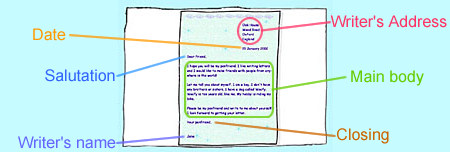
| For some practical suggestions about how you can help students focus on the layout of personal letters (including postcards and party invitations), click here: |  |
Most of the reference books available focus on students at secondary level and above. However, the following book is worth looking at as it contains a number of creative and useful ideas which you can adapt for primary students:
 |
Burbidge, N., Gray, P., Levy, S. and Rinvolucri, M. (1996) Letters Oxford University Press |
|
Tell me more ... |
 |
 |
 |
|
||
To give us feedback about this section, click here or on the Comment button at the top of the screen.
If you have any questions about this section, visit the Language Corner.
If you have any questions or suggestions about how to teach this section, send a message to the Teaching Corner.
